Art vs Money : Tragedy of the Creatives
How we leveled up an illustrator's value proposition, built a creativity framework from a project she already had, and used that foundation to create an amazeing (pun intended) derivative product to get more out of her art, her way.
Our client was a children's illustrator. Good at making things, just not great at making money from it. Unsure how to grow her business without sacrificing its creative side that she was actually interested in.
This story will explain in detail how we leveled up her value proposition, built a creativity framework from a project she already had, and used that foundation to create an amazeing (pun intended, read till the end to see) derivative product to get more out of her art, her way.
The first thing we looked at wasn't her illustrations. To be honest, even if she was a bad artist, that would've been the last thing to address.
Introduction: Price vs Values
A normal person has a straightforward view of work : easy things need less effort, simpler things more people can do - so the market is willing to pay as little as they can for it. Prices grow for what’s hard and requires more effort, or what’s complicated and less people can put together. We charge more for better results, because more time was spent or rarer skillset applied.
Any businessman quickly discovers that price is just an irrational number. You get what you’re able to negotiate. quality, time or uniqueness of the offer correlate very loosely from the price you pay.
So who wants what, and which parts do they value more?
Value is even more subjective - depending on who you ask, gluing a banana to a wall will cost you a couple of cents, 6.2 million $ or a lifetime supply of disapproving looks.
So figuring out where you land in the marketplace, is as complicated as it is uncomfortable. You must get outside of your own head and into someone else’s. Match price and values for the solution required. It’s rarely easy and never simple to negotiate.
First lesson of turning a joy into a job : the reason why we do stuff is not the reason other people want it.
A normal person tends to seek refuge from life’s uncomfortable conversations by doing things where financial profit or practicality don’t matter. Art is unsurprisingly at the top of that list. Also unsurprisingly, some people decide that creativity and passion are the way to make a living.
Any creative professional quickly discovers what a creator’s day to day is : you think, you try, you dislike the result. Nothing is done, yet everything matters. Ideas never perfectly translate to reality, no matter what you try. There are no correct answers, but some choices are better than others, although you can’t be sure which ones.
That’s why Art Work is never finished. It is only abandoned. And how artists burn out, lose their minds or even their lives.
There’s joy when it all comes together, or when you see others enjoy what you created. But the process isn’t fun.
Anyone can be funny. A career is being funny at 11:30 every Saturday for 50 years.
The people most predisposed to despair from irrational pricing of work - who committed to pursue a passion that they really care about, yet that's rarely enjoyable - must obsess about it even more cause it’s their job, but get out of their own head when evaluating what needs to be done.
Therein the real tragedy of Art vs Money : it’s ego death by commission.
Here’s how we made sure our client didn’t lose in both.
Chapter 1: Give vs Get
It's astounding how much value can be added and with how little effort, If you take a second to take care of what you already do.
Value Level +1: Make things easy.
A children's product has at least three distinct people it needs to work for simultaneously. The business that licenses and sells it. The parent who buys it. The child who either gets obsessed with it or forgets about it in thirty seconds.
Which parts of my work do I "enjoy", and which parts do I "endure"?
Besides me and my wallet, who else is this interesting for?
What does each person in the chain get from it?
What would elevate my work from "just competent" to "genuinely compelling"?
Most people will optimize for one, maybe two. But if you want to move up the value chain, that's exactly where your job description needs to start.
Value Level +2: What do we need?
What does the business need? A product with a clear identity that's easy to market and easy to reorder.
What does the parent need? Something they can feel good about — educational, quality, not disposable. What does the child need? A reason to care that has nothing to do with being educational.
That last one is the hard one. You can't reason with a seven-year-old. You can't market to them. They're either in or they're out. And the only way in is through play.
Now here's what's important to say about how we went further:
We didn't arrive at any of the final answers for the questions above by asking our client to think like a business strategist. That's a reliable way to get an artist to freeze, or worse, to produce work that's calculated rather than alive.
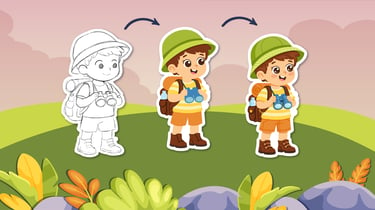
Instead, we asked her questions about the things she was already creating at the time. She came with illustrations of a boy, a girl, a tropical landscape, and pages of puzzles for kids.
Value Level +3: What do we have?
The strategic thinking that followed happened around her answers, not instead of them. The framework we made for her grew to fit the work she was already drawn to making (pun intended) — not the other way around.
How are these characters related?
What's the one theme this book is about?
What would make a kid genuinely excited to turn the page?
That distinction matters more than it might seem. A creative who's genuinely engaged with what they're making produces better work, sustains it longer, and can grow it further. Enthusiasm isn't a luxury. Especially with creativity, children, and content. It's the only business value moat left — because passion persuades. Mediocre mush and boring boilerplate are now prompted for free.
Here's where our creative educational kids illustrator client had an advantage to press:
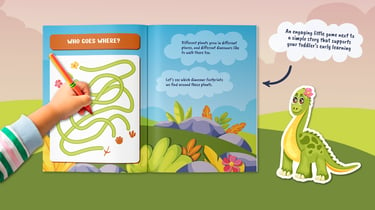
She already had puzzle templates. Mazes, tracing exercises, matching games — the mechanics of fun were there by definition. What was missing was a sandbox to play in. A game without an objective is just a collection of pictures with puzzles.
Value Level +4: Play with it.
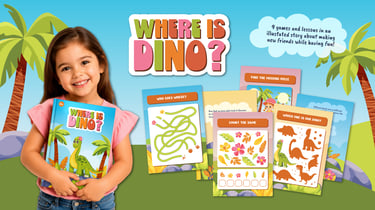
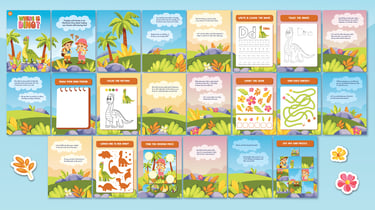
So we gamified the book even more: every activity page became a step in a larger mission. The mechanics of the puzzles didn't change, but their purpose did.
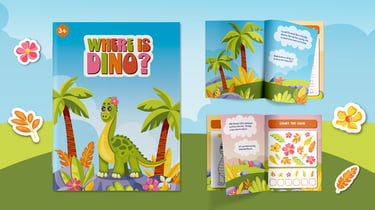
Children were now helping the characters—a boy and a girl—progress on a quest to find a little dinosaur. But we went further and gamified the educational aspect, tying the overarching objective to a real-life lesson: how to make new friends, especially with someone who is different.
Now, the gamified objective became practicing the little things that matter when making friends. This flies much better with parents than just, "Here's a collection of puzzles for your kids to play with." A collection of puzzles now had a reason to exist inside a bigger game.
Value Level +5: Tell a story about it.
We weren’t fancy with it, just added some micro-storytelling: one or two sentences per page explaining why the characters needed to solve the puzzle. Trace the letters D-I-N-O to learn his name. Trace the shapes of his scales and hoof imprints to remember what makes him special. Every individual page earns its place by connecting to something bigger than itself—showing how solving the puzzle gets us closer to Dino, and why it's a good step in making friends in general. Love it or leave it, this package is already more valuable than a collection of media assets.
The Total Package
Leo and Cleo are siblings, looking for someone to play with. Somewhere on this tropical island lives a shy dinosaur. Can they meet and become friends?
Three sentences: the difference between a folder and a book. a package or a project. price vs value.
That book now had characters with a goal. A child on the other side of the page helping someone they understood. Having fun doing something good.
We didn’t start into market positioning or value ladders or the competitive landscape for children's illustrated content.
We looked at characters she was already working on and asked: what do they want?
It sounds like a simple question. It isn't. Most products — most creative work sold as products — doesn’t truly answer it. The illustrator had answers for all this, that’s how her imagination works when she makes her art — she just hadn't been asked to use it in quite that way before.
What we got looks like it’s made by someone who knew what they wanted to make, for someone who’ll easily know what they’re buying, and the small person who would actually experience the thing, was seen as more than just a mindless consumer.
Now that we had the plan in place for making a good book, we needed a framework to make another one.
Chapter 2: One vs Many
Reassess the assets
Creating a great product is one thing. Building a system that lets an artist pursue their passion without losing it & burning out? woof.
We needed a way for our client to compound the value of her art. She’s alone, she can only create so much, and it all takes time. So getting more by doing more is a losing proposition.
Frame the work so she could picture herself doing it :
How can I create more art, without restarting the creation from scratch?
What can I reuse to add variety to my work with the least effort possible?
What’s the least I can do to make the same thing look different?
Breaking down what she had already done, what she enjoys spending time on now, and what she’d like to do in the future is the best guarantee of career longevity anyone could hope for.
Components Collection
We broke down our kids project into fundamental modules:
Parts : Rocks and foliage are quite complex shapes. Rotate them, Resize them. Modify smaller parts to differentiate similar things.
Groups: Trees and plants are combinations of smaller objects. Color-shift, bend them, resize them.
Compositions: Recombine assets to create new landmarks & scenes. Prepare a library of objects from the previous works to enrich this one.
With that understanding she can swap whatever she wants inside each module, or swap the modules themselves. Instead of restricting her, it gives her the exact right boxes to play inside of. Boxes that can be quickly assembled into vastly more valuable products.
Environment Engineering
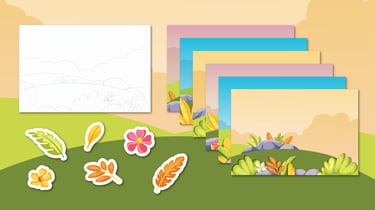
All landscapes on pages of her book can be broken down into three distinct planes:
Sky (Background): Sets the weather and time of day.
Field (Middle): The stage for the characters and the story.
Foliage (Foreground): Plants to reinforce the sense of depth.
We did 3 for every plane. Swap one plane, keep the rest - that’s 9 different pages already.
Make some more planes variations during the next project. Soon enough she’ll have a vast variety of ready to use environments with minimal effort to create and insert any of her books.
Puzzle Production
Every puzzle page features a game with “what” and a “why.”
The why is the short story—how does this help us find Dino?
The what is the puzzle itself—actively applying the lesson so the child memorizes it.
All pages have identical structure, so they’re very easy to reuse in the future no matter the puzzle.
Only 4 variables to change from game to game :
Puzzle game itself
Title : describe the action of the puzzle
Main objective: how this game helps with the main lesson of the book
Sub-story : the micro-narrative that ties this page to the previous ones
For example : Let’s make sure we know how to ask for our friend when we approach him, even if there are other kids and dinosaurs around.
Trace the letters of Dino’s name.
The pieces were already there. They had always been there. What was missing was someone to ask the obvious question — obvious, that is, once someone had asked it.
The system can work. It's thorough and tailored to fit her personally. Whether she would actually adopt it was a different question entirely — one that had less to do with the system and more to do with what creatives believe about themselves.
Chapter 3: Same vs Different
Create & Copy
“The first rule of any technology used in a business is that automation applied to an efficient operation will magnify the efficiency. The second is that automation applied to an inefficient operation will magnify the inefficiency.” – Bill Gates
It's eye opening to take a look a second, look at how we work. The ROI on time saved and foot guns avoided is only surpassed by the pleasure of remembering "wow, this used to suck and now it just flows on its own".
What does my final file usually look like? Let’s name the components that repeatedly happen.
How can I package my files so the future me, or a future colleague thanks me for it?
What scaffolding can I put in place in my workflow so starting a similar project eliminates mess and busywork?
What would an effortless launch of a new project look like? What actions move me further away from it?
It takes time and thought to answer these questions, to commit building a work environment as personal. so most people say fuck it. And never find out the hidden side effect of these technical questions : they force you to better form your personal art style
Remix & Redistribute
Because her art is now structured as a system, her book alone is already primed for multiple monetization streams:
Print-Ready: Files fully prepared for printed books that kids can draw on directly.
Digital Media: Editable, lossless vector assets ready for export at any dimension and resolution.
Interactive Experiences: Organize layers and files for easy rigging, animation, and game development.
Fuck Around & Find Out
Creatives look down on the words ‘framework’, ‘template‘, 'modular'. It sounds like a factory floor thing, incompatible with the passions that push people to create art. We’re in to do stuff like Monet, Michelangelo, Miyazaki. who the fuck is inspired by “the creative” that marketing teams must make, so MBA muggles can minmax metrics that make them money?
Ads Aren’t Art.
Boo Boring Business BS.
Creativity = Chaos…
Live, Love, Leave others deal with the mess you created.
the next 4 hours were spent creating a merch line about messy layers
Experienced creatives, ones with an actual career speak of, learn to tolerate templates. Constrain the creative chaos so it’s channeling their creativity, instead of impeding it. If you’re a solo creator and a business beginner, that tolerance to template thinking takes time to (alright, i’m gonna stop)
(I don’t know what’s the deal with this alliteration stuff. Once it starts, the words just come to me this way. Anyways…)
Next Stage: The Live App
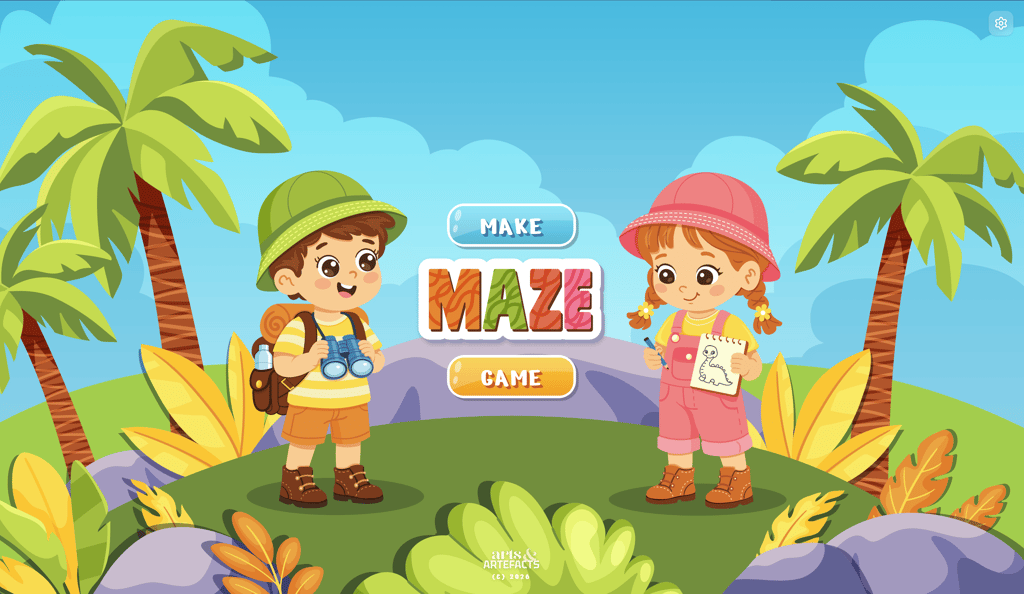
Most "consultants" wouldn't do half of what we set up. The usual approach is to do a little contained project, package it, take the money and move on to the next thing. But we didn't even stop at after all of the above. To prove the power of this modular system, we took one of the mechanics — the maze game —and developed a maker tool and digital game around it.
So our illustrator could effortlessly produce endless new mazes using a simple SVG path-making tool - that specifically complement her game page templates. Better yet, she could sell an actual digital game based around that tool, utilizing her existing environment layers for backgrounds and her characters for the start and end points.
That's how an artist avoids ego death by commission.
You can check all of it below. However to do justice to stage of our collaboration, its story deserves a dedicated article.